
Crafting Interactive Systems for Learning, Wellbeing, and Inclusion
CHISEL is a participatory design lab working at the intersections of human-computer interaction, design and social psychology — with and for communities at the margins in the global south.
 Housed at the Syed Babar Ali School of Science & Engineering, LUMS
Chisel is a hub for innovative and inclusive design practices. We use a participatory design approach to focus on learning and healthcare technologies, particularly for people within the margins in the global south.
Our inclusionary research goal is to use design and technology to engage, empower and educate the community. Chisel's research interests lie at the intersections of human-computer interaction (HCI), design and (social) psychology, primarily focusing on assistive and educational technologies for special user groups, child-computer interaction, and ICT4D.
Learn more about the lab →Tech-enhanced Learning & AI
How technology can support children with diverse learning needs, and what role it should play in the wider K-12 landscape — studied in classrooms rather than modelled from outside them.
Well-being & Mental Health
Digital screening, rehabilitation and support: interactive systems that help identify a condition earlier, sustain therapy between sessions, and reach people for whom formal care is distant or stigmatised.
Inclusion
Who is left outside a technology and why, studied with the communities concerned — access, safety and participation for people the design process rarely reaches.
Research in the field
Virtual Reality Therapy for People with Mild Cognitive Impairments
Dementia · Extended Reality Lab · with caregivers in Lahore
Student Mental Health Risk Modelling
Mental health · Ongoing · machine learning risk model, data collection underway
Teaching Pakistan Sign Language with the Pepper robot
Inclusion · Social robotics · Ongoing, prototype in development
Peer-reviewed work at CHI, IDC, INTERACT, ICTD and beyond.
A. Dangol, S. Kotiyal, R. Wolfe, A. J. Bowers, and others
M. S. T. Hassan, C. U. Alam, A. Irfan, S. Shahid
S. Naseem, M. Malik, H. Tarar, S. Shahid
CHISEL:ReMIND
Human-centered digital pathways to mental wellbeing.
ReMIND brings the lab's mental health work under one programme: digital screening that identifies conditions earlier, rehabilitation tools that sustain therapy between sessions, and support designed for settings where formal care is distant or stigmatised.
About ReMIND →A VR lab built for healthcare research.
Our immersive facility supports studies across the life course — from children with autism learning social and sensory skills, to older adults recovering from stroke or living with dementia.
Sessions run with participants who have usually never worn a headset before, alongside clinicians and families. Room-scale tracking, dedicated GPU workstations and physiological sensing let us measure what happens rather than infer it.
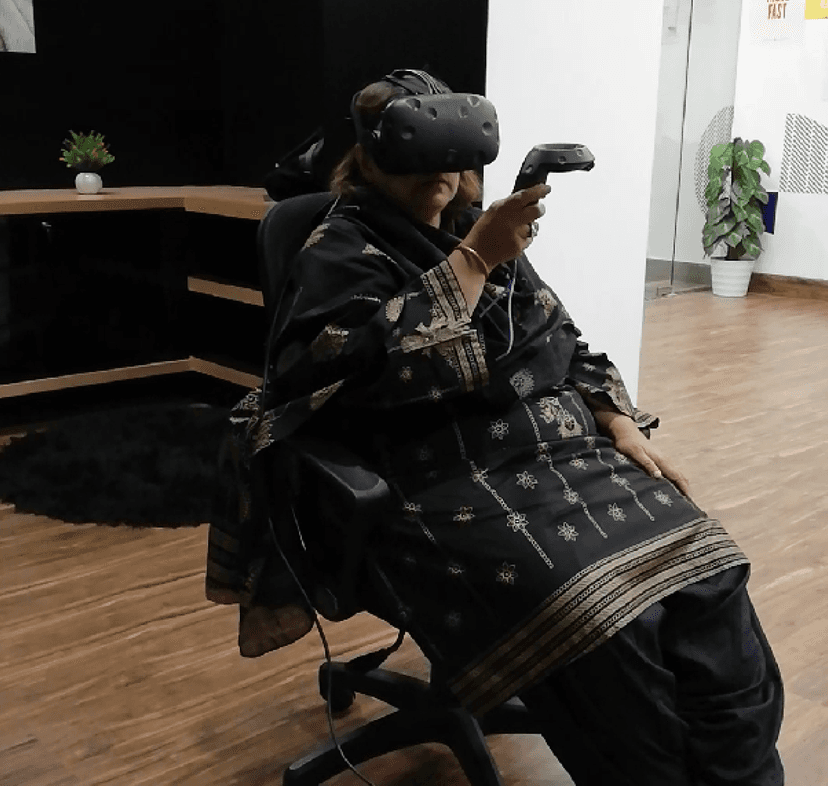 A participant in the VR lab
Disability Innovation and Inclusion Center
DIICE works on technology, policy and practice for disabled communities in Pakistan, and shares much of its research agenda with the lab.
About DIICE →